
Tert-Butanol CAS 75-65-0
Product Introduction: Learn verified uses, storage rules and safety specs for tert-butanol CAS 75-65-0. This versatile tertiary alcohol works as a chemical intermediate, industrial solvent and oxygenated fuel additive.
-
CAS No.: 75-65-0
-
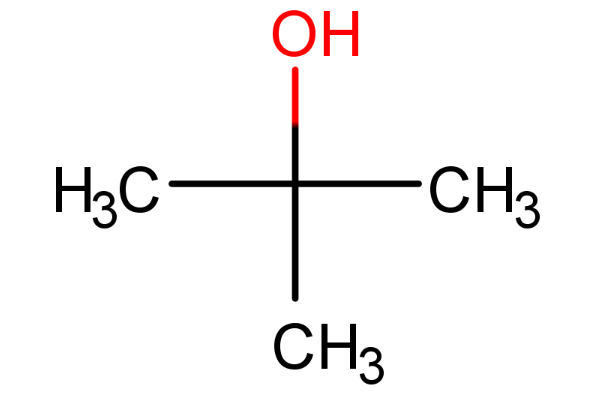
Molecular formula: C4H10O
-
Samples: Free samples under 100g
Specifications:
| Item | Specification |
| Purity | ≥99% |
| Density | 0.786 |
| Melting point | 23-26 °C |
| Boiling point | 77.9 °F (NTP, 1992) |
| Refractive index | 1.386-1.388 |
| Flash point | 52 °F (NTP, 1992) |
| Vapor pressure | 31 mm Hg (20 °C) |
| PSA | 20.23000 |
| logP | 0.77720 |
| Appearance | Colorless crystals or liquid with a camphor-like odor |
Application:
1). As a tertiary alkylation feedstock, tert-butanol is the primary precursor for tert-butyl functional groups in organic synthesis. It reacts to form tert-butyl phenol, tert-butylamine and tert-butyl methacrylate, which are building blocks for plastics, rubber antioxidants and polymer additives.
2). In agrochemical production, it is a critical intermediate for insecticides, acaricides and herbicides.
3). Tert-Butanol acts as a high-power solvent in paints, inks, varnishes and adhesive formulations, where it improves flow leveling and dissolves resin binders effectively.
4). It also serves as a reaction solvent for free-radical polymerizations, where it dissolves monomers without interfering with reaction kinetics.
5).In biofuel formulations, it acts as a co-solvent to improve low-temperature flow properties and stabilize fuel blends. It is also used as a process additive in lubricant production.
Storage:
1). Tert-Butanol is a highly flammable liquid with a closed-cup flash point of 11°C. Its vapor forms explosive mixtures with air over a 1.7–8.0% volume range. It solidifies into colorless crystals at temperatures below 25.7°C; this is a reversible physical change.
2). Store in tightly sealed, grounded metal or approved plastic containers in a cool, dry, well-ventilated flammable-liquid warehouse. Maintain storage temperatures between 5°C and 30°C. If crystallization occurs, gently warm containers to 30–35°C in a water bath and mix thoroughly before use. This process does not degrade product quality.